
What Is a Second Brain in Marketing?
And Why Your Best Ideas Keep Slipping Through the Cracks
- Mark E
- July 16, 2026
- Guide
The system that turns scattered notes, dead Slack threads, and one person’s memory into marketing that compounds.
You had a sharp campaign idea three weeks ago. It came up in a meeting, someone said ‘we should do that,’ and everyone nodded. It’s gone now.
Nobody wrote it down. Or someone did, in a doc nobody can find. This happens every week in most marketing teams. Not because the people aren’t smart. Because the ideas have nowhere to live.
A second brain in marketing fixes exactly that. It’s a system that captures what your brand knows, the insights, the research, the voice, the wins, and hands it back to you when you need it. Part filing system, part memory, and now part fuel for the AI tools your team already uses.
This guide breaks down what a second brain actually is, why marketing teams lose without one, what goes inside it, and how to build yours without it becoming a second job.
What a Second Brain Actually Means
The term comes from Tiago Forte and his book Building a Second Brain. The core idea is simple: your brain is for having ideas, not holding them. So you offload everything you learn into a trusted system outside your head.
In marketing, that system isn’t just a note app. It’s a living record of how your brand thinks. Customer insights. Positioning. Brand voice. What worked, what flopped, and why. It captures information, organizes it, and feeds it back into decisions and content.
Your brain is for having ideas. Your second brain is for keeping them.
Why Marketing Loses Without One
Most marketing runs on memory. Ask why last quarter’s campaign worked and the answer usually lives in a Slack thread, a forgotten dashboard, or one person’s head.
Then that person goes on leave. Or leaves. And the context leaves with them.
The result is predictable. Teams repeat experiments that already failed, relearn lessons they already paid for, and publish content that sounds different every week because nobody agrees on the voice. It’s the same root problem behind a weak, inconsistent brand and random content with no strategy.
It shows up in paid too. Plenty of ad budget gets burned rediscovering what a team already knew. We broke down a version of this in why your ads get clicks but no conversions.
Marketing rarely fails from a shortage of ideas. It fails from a shortage of memory.
The Two Second Brains You Need Now
A second brain used to have one job: help you remember. Now it has two.
- The human system. Capture and organize what your brand knows so your team stops starting from zero on every brief.
- The AI second brain. The same knowledge, written so AI tools can actually read it. This is the part everyone is talking about, and the part most teams get wrong.
Here’s the pattern. A team buys ChatGPT or Claude, runs a few prompts, gets bland output, blames the tool, and quits within a month. The tool was never the problem. You asked a brilliant generalist to work for a company it had never heard of, for an audience it had never met, in a voice it had never read. Of course it came back generic.
The tool isn’t the differentiator anymore. The context you feed it is.
What Goes Inside a Marketing Second Brain
You don’t need to capture everything. You need to capture the things that shape every decision and every piece of content. Six categories cover most of it:
- What you do, who it’s for, and why your way beats the alternatives.
- Your ICP and personas. Who you sell to and how they actually make decisions. If you haven’t defined this properly, start with our guide to buyer personas.
- Brand voice. How you sound, backed by real examples of on-brand and off-brand writing. Examples teach an AI far more than adjectives do.
- Visual identity. Colors, type, logo rules, and the do’s and don’ts.
- Offers and pricing. What you sell, to whom, and at what price. A clear, productized offer is far easier to feed a system than a vague list of services.
- Frameworks, proof, and a swipe file. Your best case studies, testimonials, and a running swipe file of ideas and formats worth borrowing from.
Simple test: if a new hire or an AI can’t do good work from these files alone, the files aren’t finished yet.
Two Methods That Make It Work: CODE and PARA
You don’t need a complicated setup. You need two habits.
CODE stands for Capture, Organize, Distill, Express. It’s how information moves through your system. You save what resonates, sort it, pull out the essence, then turn it into work you ship.
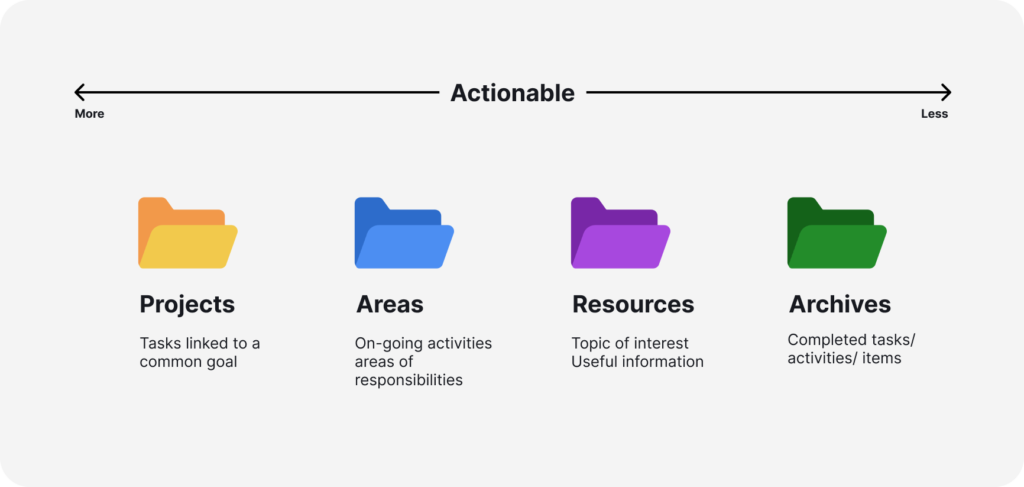
PARA stands for Projects, Areas, Resources, Archives. It’s how you file everything, by how actionable it is rather than by vague topic. Active projects up front. Reference material and archives in the back.
CODE is the habit. PARA is the filing cabinet. Use both and the system runs itself.
Why This Matters More in the AI Era
Two years ago, prompting was the skill. Today the models are good enough that prompting is a small lever. Context is the big one.
AI doesn’t fail because of capability. It fails because of context. A second brain is how you hand every tool, ChatGPT, Claude, the AI baked into your ad platform, the same context your best strategist carries in their head.
Without it, you scale generic. With it, you scale your brand. And when everyone has access to the same models, the context you own becomes the only real edge.
Generic content is cheap now. On-brand content is the moat.
How to Build Your Marketing Second Brain (Start in an Afternoon)
Don’t try to build the perfect system. Build one that exists, then improve it.
- Pick one home. One source of truth. Notion, Google Drive, or a plain folder. Don’t scatter it across five tools.
- Capture without friction. If saving an idea takes more than a few seconds, you won’t do it. Make it effortless.
- Organize with PARA. Four folders. Projects, Areas, Resources, Archives. That’s the whole structure.
- Distill as you go. Don’t hoard raw screenshots and links. Pull out the one-line lesson so future you gets it in seconds.
- Feed your AI. Turn your positioning, ICP, and voice into short files your tools can read. Markdown works best because it’s clean and lightweight.
Start with three files: positioning, ICP, and brand voice. That alone will sharpen every output you generate. Expand from there.
Common Mistakes to Avoid
- If you spend more time maintaining the system than using it, it has failed. Keep it simple.
- Hoarding without distilling. A pile of raw data isn’t knowledge. The value is in the insight you pull out.
- Treating AI as a replacement for strategy. A second brain makes good strategy scale. It doesn’t invent it for you.
- Building it once and forgetting it. A brain that never updates is just an archive. Feed it as you learn.
The Takeaway
If your marketing lives in five tools and one person’s memory, that’s not a system. That’s a risk.
A second brain is how ideas stop dying in meetings and start compounding into an advantage. It keeps your brand consistent, your team fast, and your AI output sounding like you instead of the internet.
Tools capture. Systems compound.
Your brain is for having ideas. Your second brain is for keeping them.
Stop starting from zero.
Clayrio helps startups and SMEs turn what their brand knows into marketing that compounds. If you want help building a content engine and brand system that scales, explore our